















A recent World Health Organization study detailing elevated levels of micro-plastics in bottled water shows we may be witnessing a poetic justice for our oceans. An upward of 90% of bottled water may contain micro-plastics that could damage human health, so while we have spent half a decade polluting the waterways with plastic, those water supplies may now be polluting us.
From Bakelite Radio to the Bottle Top
In 1907, a Belgian-born American named Leo Hendrik Baekeland made a startling discovery: If you mix a phenol and formaldehyde, you end up with a synthetic material with which you can use to make all sorts of exciting objects.
It did not take long for the invention to find its way into the everyday goods. These include telephones, snooker balls and radios. During the 1940s, the industry kicked off the modest production of plastic bottles. These were expensive to produce due to constraints in the manufacturing capabilities at the time. This rapidly expanded into a global enterprise, producing more than one-hundred million metric tons of plastic by 1989.
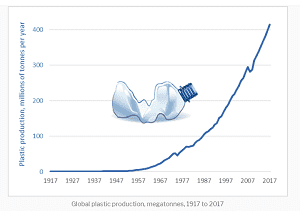
Image: http://www.darrinqualman.com/global-plastics-production/
While plastic consumption stabilized in Europe at the turn of the millennium, we have witnessed the rise of plastic production by a staggering 67.5 percent across the globe since 2002. Moreover, where Europe has experienced modest population growth in the last fifteen years, population expansion at a global level remains on a steep upward trajectory. As the global population grows and plastic consumption increases per capita, these two trends suggest the problem will only intensify.
Seas of Plastic: What’s to Blame?
Did you know we have produced a cumulative total of more than 9 billion tons of plastic in the last 67 years; producing more plastic in the last ten years than during the whole previous century.Just 9 percent of all plastic has ever been recycled; 12 percent incinerated and the remainder has made its way to landfill – or worse, the ocean. If we look for a primary suspect, most indicators point back to one thing: the invention of the plastic bottle, which is now used to excess and has resulted in the suspended islands of rubbish that now plague the globe.
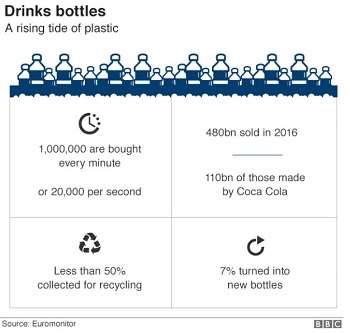
Image: http://www.bbc.co.uk/news/science-environment-42264788
In a recent discovery, Captain Charles Moore drifted into a garbage patch greater in size than Mexico, which is yet another reminder of just how grave and under-estimated the current crisis is. The fact that such extensive wastelands have accumulated at sea with little-to-no realization should sound the alarm.
Even more arresting is an estimation that the seas contain a plastic-to-plankton ratio of 1:2. Given the importance of this tiny foodstuff in sustaining broader populations of marine life, there are significant grounds for concerns around micro-plastics entering the waterways.
By many estimates, most of the plastic ever produced is still in existence. Most of plastics never biodegrade in a meaningful manner, instead break down into ever-smaller particles. The long-standing effect on the ocean is beyond comprehension.
While it’s clear the plastic bottle has a lot to answer for, an equally disturbing fact points the finger in only a handful of directions. Just ten rivers across the globe contribute upwards of 90 percent of plastic pollution. While such a concentration highlights that the few must take significant action to redress the imbalance, everyone has a pivotal role to play in reducing unnecessary consumption.
How to Turn the Tide on Ocean Pollution
Several Australian stores have already taken measures to ban plastic bags. Others have removed plastic from produce lines, which could save as much as 25 ton of packaging annually. A store in Amsterdam recently unveiled the first plastic-free aisle in what could be a watershed moment for the world. Should such an initiative prove to be successful, others could soon follow suit.
There are many simpler ways you can contribute to reducing plastic pollution.
Say No to Single Use:If you’re offered a single-use item such as straws, bottles, cutlery, coffee cups or plastic bags, just say no. Australians go through as many as 13 million new bags a day. Carry your own reusable version such as reusable metal straws, invest in refillable bottles and bottleless water coolers to stay hydrated, cloth bags for your groceries and refillable coffee cups. You can also join The Last Straw campaign and help end single-use for good.
- Avoid Packaging: Plastic-free aisles are rare but choose foods with minimal packaging; and buy loose fruit and vegetables where possible.
- Avoid Microbeads: Avoid health and beauty products with micro-beads and avoid any product that contains the worst types of plastics: Polyethylene (PE), polypropylene (PP), polyethylene terephthalate (PET), polymethyl methacrylate (PMMA), polytetrafluoroethylene (PTFE) and nylon.
- Don’t Buy Disposable: Single use items such as razorscontribute excessive waste – opt for razors with replaceable blades.
- Choose Your Takeaway Wisely: Food packaging, including hot food, is often one of the worst offenders with polystyrene (PS) an especially damaging plastic.
- Does It Come in Glass? Ask yourself if you can buy the product in a glass container. Products such as sauces, dressings, marinades and pickles all come in glass packaging. Anytime you make a purchase, favor glass over other forms of packaging, and re-use your old glass. If you can’t re-use, recycle.
We are at a tipping point; unless we make conscious changes to our consumption habits immediately, there is every risk we will have more plastic than fish in our oceans by 2050. To reduce the volume of plastic entering our ocean by 90 percent and reduce the amount of plastic in the ocean by half, we must do two things with the support of research and innovative actions:
Even at this rate, it could still take up to ten years to return the oceans to a more acceptable state. Therefore, it is more important than ever to be mindful of plastic packaging, explore reusable alternatives and take part in local activities to rid your community of plastic waste.
Our thanks to Edward Hull, Outreach Coordinator, Waterlogic for this informative piece.
Allied Pumps is a leading supplier of At Source Gross Pollutant Traps, Stormwater Treatment and Hydrocarbon Capture and Waste Water Treatment Trains. Read more about the work we do to help combat the rising tide of plastic pollution.
Contact Allied Pumps today to discuss your water management needs.